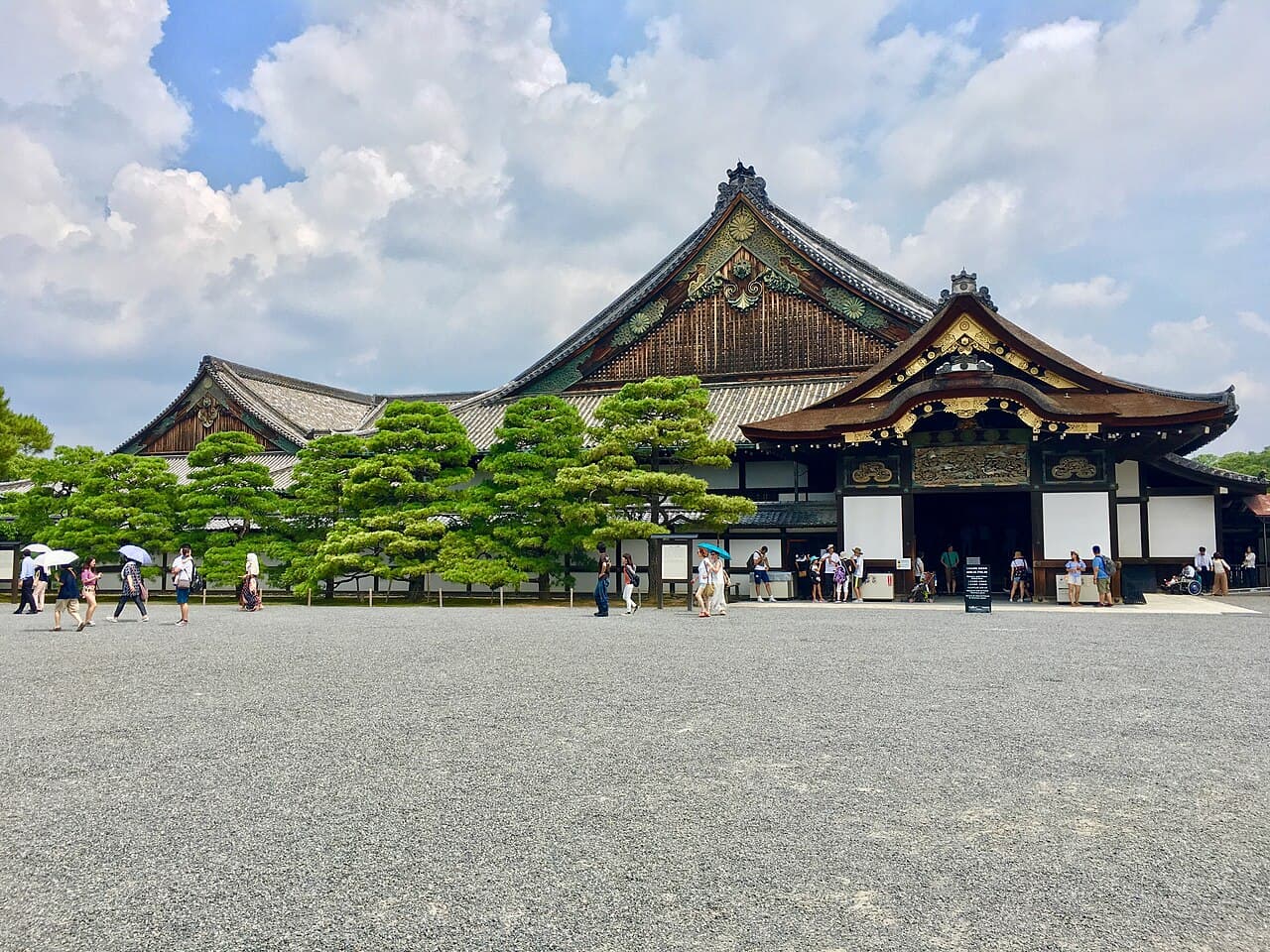
If you walk through the vast gravel expanse of the Kyoto Gyoen National Garden, you will eventually hit a wall. A very long, very beige, earthen wall. Behind it lies the Kyoto Imperial Palace (Kyoto-gosho), the home of Japan's Emperors for over 500 years until the capital packed its bags and moved to Tokyo in 1869.
For many travelers, the palace is a checkbox. It’s big, it’s famous, and admission is free. But to the untrained eye, it can also feel a bit... empty. There are no samurai armors on display, no golden tea bowls, and you can’t actually enter the buildings.
But emptiness in Kyoto is never just emptiness. This palace is a masterclass in symbolism. It is a monument to a time when the Emperor was a living god with zero political power. Or put metaphorically, when the Emporor was a sacred bird trapped in a beautiful, wooden cage. To visit the palace is to walk the fault line between spiritual authority and military might. It is a place of quiet resistance, ancient ritual, and architectural elegance that refuses to show off.
Here is how to read the silence of the Imperial Palace.
The Architecture of divine Simplicity
When you step through the Seishomon Gate, the first thing that strikes you is the restraint. If you’ve just come from the gold-leafed explosion of Kinkaku-ji or the intricate carvings of Nijo Castle, the Imperial Palace feels almost shockingly plain.
This is by design. The palace is built in the shinden-zukuri style, an architectural language that dates back to the Heian period (794-1185). It prioritizes unpainted cypress wood, white plaster, and roofs made of compressed cypress bark (hiwadabuki).
The Evolution of a Style
The buildings you see today aren't the originals. In a city made of wood and paper, fire is a constant eraser. The current structures date mostly from 1855, rebuilt after a devastating blaze. But here is the fascinating part: they were rebuilt to look older than the buildings they replaced.
The 1855 reconstruction was a deliberate attempt to revive the aesthetic of the Heian "Golden Age." In the mid-19th century, as Japan faced pressure from foreign powers and internal unrest, the court looked backward for stability. They recreated the architectural style of an era when the Emperor was paramount, rejecting the ornate, Chinese-influenced styles favored by the samurai class.
The result is a complex that feels timeless. The sweeping roofs and open verandas are designed to blur the line between interior and exterior, inviting the garden inside. It is an architecture of harmony, not defense. Unlike a samurai castle, there are no moats filled with spikes, no "nightingale floors" to chirp at assassins, and no arrow slits. The Emperor’s defense was his divinity. Who would dare attack a god?
The Edict that Changed Everything
Among these serene halls, one of the most explosive moments in Japanese history occurred. On December 9, 1867, in the Ogakumonjo (Small Study Hall), the "Edict of the Restoration of Imperial Rule" was issued.
This piece of paper dismantled the Tokugawa Shogunate, which had ruled Japan with an iron fist for 260 years. It stripped the Shogun of his title and returned political power to the young Emperor Meiji. It was the birth certificate of modern Japan, signed in a room designed for poetry and study.
The Priest-King: The Palace as a Shrine
To understand the palace, you have to stop thinking of it as a government building and start thinking of it as a church.
For most of Japanese history, the Emperor wasn't a king in the Western sense. He was the Tenno, that is, the Heavenly Sovereign. He was the high priest of Shinto, a direct descendant of the Sun Goddess Amaterasu. His job wasn't to write laws or command armies; it was to exist. His presence alone maintained the cosmic balance of the nation.
The Shishinden: The Throne of Heaven
The heart of this spiritual duty is the Shishinden (Hall for State Ceremonies). This is the most important building on the grounds. It is a massive, single-story hall facing a courtyard covered in white gravel.
Inside sits the Takamikura, the octagonal, curtained throne of the Emperor. This is where the enthronement ceremonies for Emperors Meiji, Taisho, and Showa took place. Even today, though the capital is in Tokyo, the Takamikura remains here, a potent symbol that the spiritual roots of the throne are still dug deep into Kyoto soil.
The Rituals of Prosperity
Life inside these walls was a ceaseless calendar of rituals. The Emperor performed over 20 major rites annually to ensure the harvest and the safety of the nation. One example is Niinamesai: The Festival of First Fruits, where the Emperor offered the new rice harvest to the gods and partook of it himself. Another is Shiho-hai: The New Year’s rite of bowing to the four directions to pray for peace.
These weren't public spectacles; they were private communions with the divine. The palace grounds are dotted with sacred spaces like the Kashikodokoro, a sanctuary that once housed the Sacred Mirror, one of the three Imperial Regalia. Walking through the palace, you are walking through a space that was designed to be pure enough for the gods to inhabit.
The Tale of Two Castles: The Imperial Palace vs. Nijo Castle
You cannot fully appreciate the Imperial Palace without visiting its neighbor, Nijo Castle, located just a twenty-minute walk to the west. They are the yin and yang of Kyoto’s history, a dialogue in wood and stone about who really ran Japan.
The Shogun’s Flex
In 1603, the warlord Tokugawa Ieyasu had just unified Japan. The Emperor was still technically the sovereign, but Ieyasu held the guns. To make this power dynamic clear, Ieyasu built Nijo Castle.
He placed it aggressively close to the Imperial Palace. He built it massive, with stone walls and a donjon that towered over the Emperor’s home. While the Imperial Palace is all unpainted wood and subtlety, Nijo Castle is an explosion of gold leaf, colorful carvings, and ostentatious wealth. It was a calculated architectural insult. It said, "You may have the blood of the gods, but I have the gold."
Loading listing...
The Great Irony
History, however, has a sense of humor. Nijo Castle was built to intimidate the Emperor, but it became the stage for the Shogun’s surrender.
In 1867, the 15th Shogun, Tokugawa Yoshinobu, stood in the Great Hall of Nijo Castle and formally returned power to the Emperor (the event known as Taisei Hokan). The fortress built to cage the Imperial institution became the site of its liberation.
To add a final layer of historical irony: In the late 19th century, after the Emperor regained power, a building from the Imperial Palace (the Katsura-no-miya) was physically moved inside the walls of Nijo Castle to replace a burned-down palace. The Emperor literally moved into the Shogun’s house.
How to Visit: A Practical Guide
Visiting the Imperial Palace used to be a bureaucratic nightmare involving advance applications and passports. Today, it is refreshingly easy.
1. No Reservations Needed. You can simply walk up to the Seishomon Gate (on the west side) and enter. Admission is free.
2. The Hours. The palace is generally open from 9:00 AM to 4:00 PM (last entry), though hours extend slightly in summer. Crucially, it is closed on Mondays. If Monday is a holiday, it closes Tuesday.
3. Take the Free Tour. While you can wander the sign-posted route yourself, the free English guided tours (usually at 10:00 AM and 2:00 PM) are excellent. The guides unlock the context of the buildings that otherwise just look like "nice wooden halls." You don't need to book; just show up at the visitor center inside the gate.
4. Wear Good Shoes. I cannot stress this enough. The paths through the palace are covered in deep, loose gravel. It is murder on high heels and thin-soled sandals. Wear sturdy walking shoes, or you will spend the entire visit thinking about your feet instead of the Emperor.
5. Don't Miss the Oikeniwa. While the big ceremonial halls get all the attention, the Oikeniwa Garden is the aesthetic highlight. It’s a strolling pond garden with a shoreline covered in smooth, round stones. It is one of the few places in the complex where the rigid formality relaxes into pure beauty.
6. Combine with Nijo Castle. For the full historical whiplash, visit the Imperial Palace in the morning and Nijo Castle in the afternoon. The contrast between the Emperor’s "divine simplicity" and the Shogun’s "military bling" tells you more about Japanese history than any textbook.
The Verdict
The Kyoto Imperial Palace is not a place that screams for your attention. It whispers. It asks you to slow down and notice the curve of a roof, the raked lines of the gravel, and the weight of the silence.
It stands as a testament to the strange resilience of the Japanese monarchy, which is an institution that survived centuries of irrelevance to emerge, phoenix-like, as the center of the modern nation. It is a beautiful, quiet, and deeply significant void in the center of the bustling city. Walk the gravel, feel the history, and pay your respects to the ghosts of the gods.