Let’s be honest. The first time you see a proper Japanese dry landscape garden, you might find yourself thinking, “Okay… it’s rocks and sand. Am I missing something?”
You stand on a wooden veranda, looking out over a meticulously raked rectangle of gravel dotted with a few moss-fringed boulders. It’s quiet. It’s still. And it can feel utterly impenetrable. However, these gardens, known as karesansui (枯山水), are one of Japan’s most profound art forms. A philosophical statement rendered in stone.
The name itself is the first clue. Kare (枯) means "dry" or "withered." San (山) is "mountain," and sui (水) is "water." Dry mountain water. It’s a beautiful paradox. These gardens are designed to evoke the grandest scenes of nature such as cascading waterfalls, vast oceans, and rugged mountain ranges using none of the actual elements. They are invitations for your mind to do the work, to see the river in the raked lines and the island in the stone. They aren't gardens for strolling, but canvases for contemplation.
From Sacred Stones to Zen Abstraction
The idea of arranging rocks with intention didn’t just appear out of nowhere with Zen Buddhism. Its roots run deep into Japan's ancient, animistic Shinto past. Long before temples, there was a belief in iwakura, that is, massive, sacred stones believed to be temporary homes for the gods (kami). These divine anchors served as the origin of deep-seated reverence for the spiritual power of stone, forming the bedrock of all Japanese garden design.
Fast-forward to the Heian period (794-1185), and Japan’s first garden manual, the Sakuteiki, already describes creating a kare-sansui where a pond or stream isn't practical. But the art form truly crystallized during the Muromachi period (1336-1573). As the austere values of the samurai class and the discipline of Zen Buddhism took hold, gardens transformed. They became less about recreating literal landscapes and more about creating tools for meditation.
Zen monks, who often doubled as artists and designers, began creating stark, minimalist gardens intended to quiet the mind and provoke insight. They were painting with stone and sand, stripping nature down to its essential bones to reveal a deeper truth.
The Grammar of the Garden
A karesansui garden might look simple, but its composition is governed by a strict set of aesthetic and philosophical principles. Understanding this grammar is the key to reading the rocks.
Rocks, Sand, and Emptiness
The palette is intentionally limited. Rocks are the main actors. They can be mountains, islands, animals, or even Buddhist deities. Their selection and placement are the most critical acts of creation. The white gravel (or shirakawa-suna) represents water, but it also represents emptiness known as ma (間).
In Japanese aesthetics, ma is not a void. It’s the pregnant pause in a piece of music, the unpainted space in a scroll painting that gives the composition room to breathe. The vast, raked sea of gravel is more than filler. Rather, it’s an active element that defines the rocks and gives your mind a place to rest and wander. The act of raking itself, often performed daily by monks, is a form of active meditation, a ritual of focus and discipline.
The Beauty of Being Off-Balance
You will almost never find perfect symmetry in a karesansui garden. This is deliberate. The principle of fukinsei, or asymmetry, is central to the aesthetic of wabi-sabi, which celebrates the beauty of imperfect, impermanent, and incomplete.
Perfect balance feels artificial, static, and dead. Asymmetry feels natural, dynamic, and alive. Rocks are often arranged in odd-numbered groups (threes, fives, sevens), creating a tension and balance that is much more complex and engaging than a simple mirror image. This appreciation for the imperfect extends to the materials themselves: the weathered face of a rock, the creep of moss, and the temporary nature of the raked lines. They all serve as reminders of time's passage and the transient beauty of the world.
Three Kyoto Gardens, Three Different Stories
Kyoto is the heartland of karesansui. While dozens of examples exist, visiting a few key gardens reveals the incredible diversity of expression possible within this strict art form.
Ryōan-ji: The Ultimate Riddle
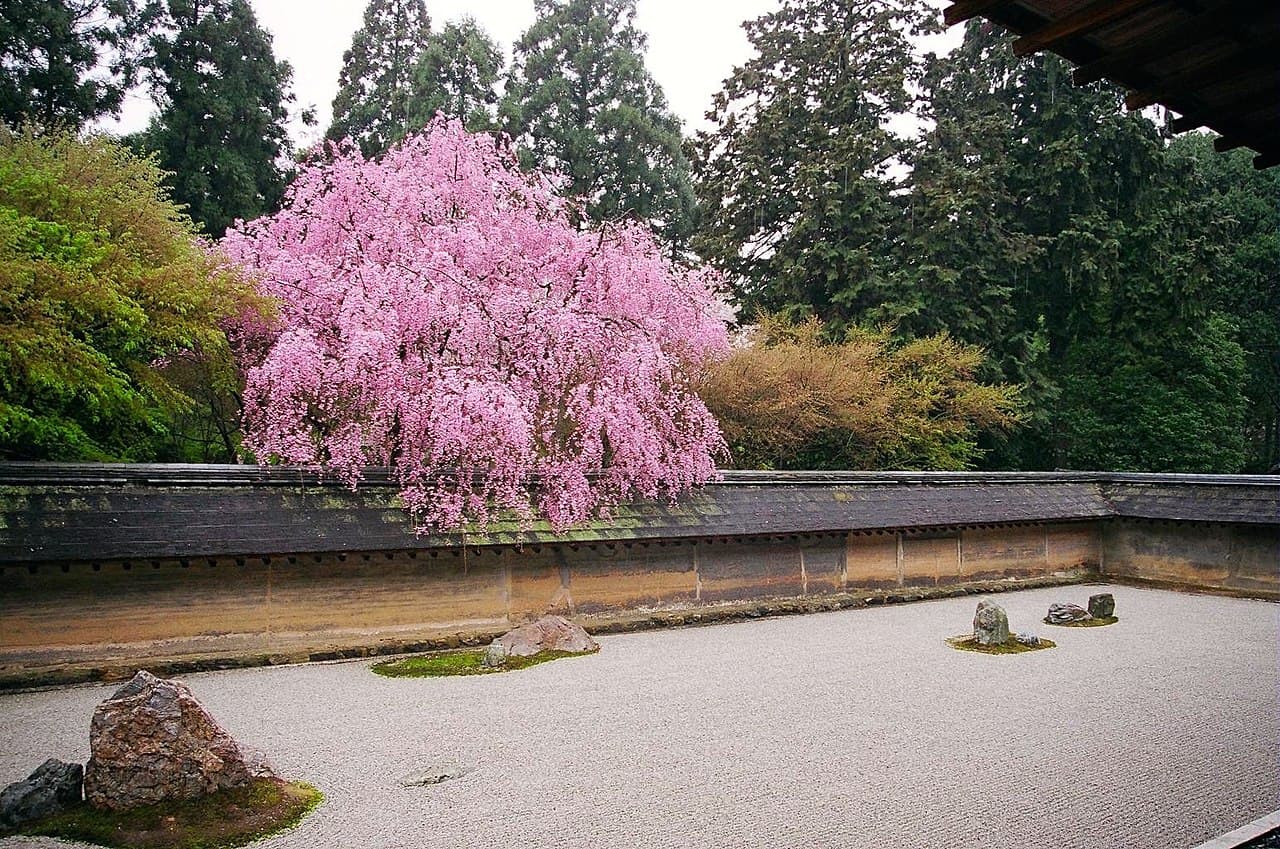
If there is one karesansui known around the world, this is it. The garden at Ryōan-ji is the epitome of abstraction. Fifteen stones of varying sizes are set in five mossy clusters, floating in a sea of perfectly raked white gravel. That's it. There is no obvious story, no clear representation.
Its most famous feature is its clever composition: from any single vantage point on the veranda, at least one stone is always hidden from view. Interpretations abound. Is it a tiger leading her cubs across a river? A map of constellations? A lesson that complete understanding is impossible? The garden refuses to give a straight answer. It’s a kōan in stone, a riddle designed not to be solved but to be experienced. It forces you to let go of the need for meaning and simply be with the composition.
Loading listing...
Daisen-in: A Journey in Stone
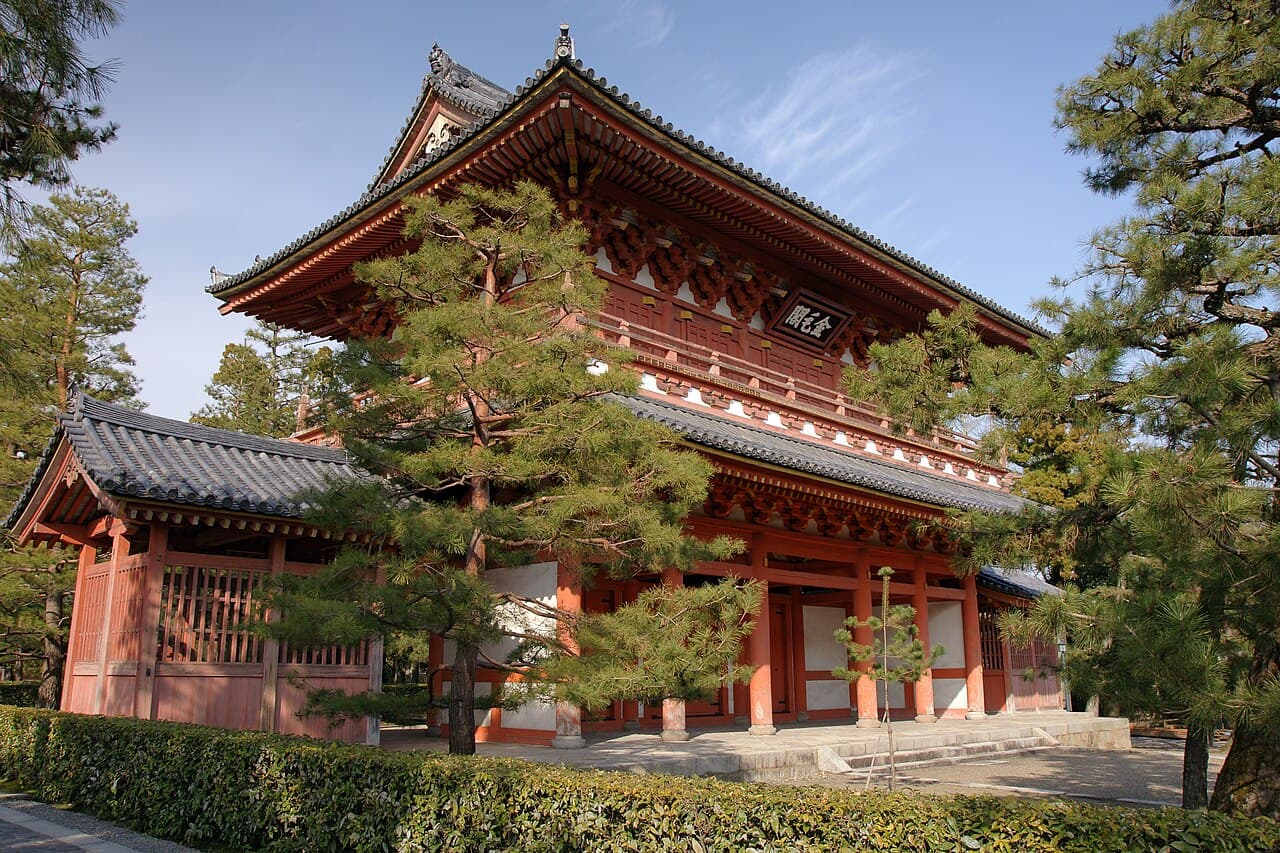
In stark contrast to Ryōan-ji’s ambiguity, the garden at Daisen-in, a sub-temple of Daitoku-ji, tells a clear and powerful story. It’s a three-dimensional scroll painting that wraps around the building, depicting a metaphorical journey through life.
The garden begins with a sharp, vertical rock representing a mountain, from which a dry waterfall of gravel tumbles down. This "river" flows through symbolic rapids and obstacles, passes under a stone boat meant to carry souls to paradise, and finally empties into a broad, calm "ocean" of white gravel. To view Daisen-in is to follow a narrative from the turbulent beginnings of life to a tranquil, enlightened end. It’s a masterful piece of visual storytelling.
Loading listing...
Tōfuku-ji: A Modern Masterpiece
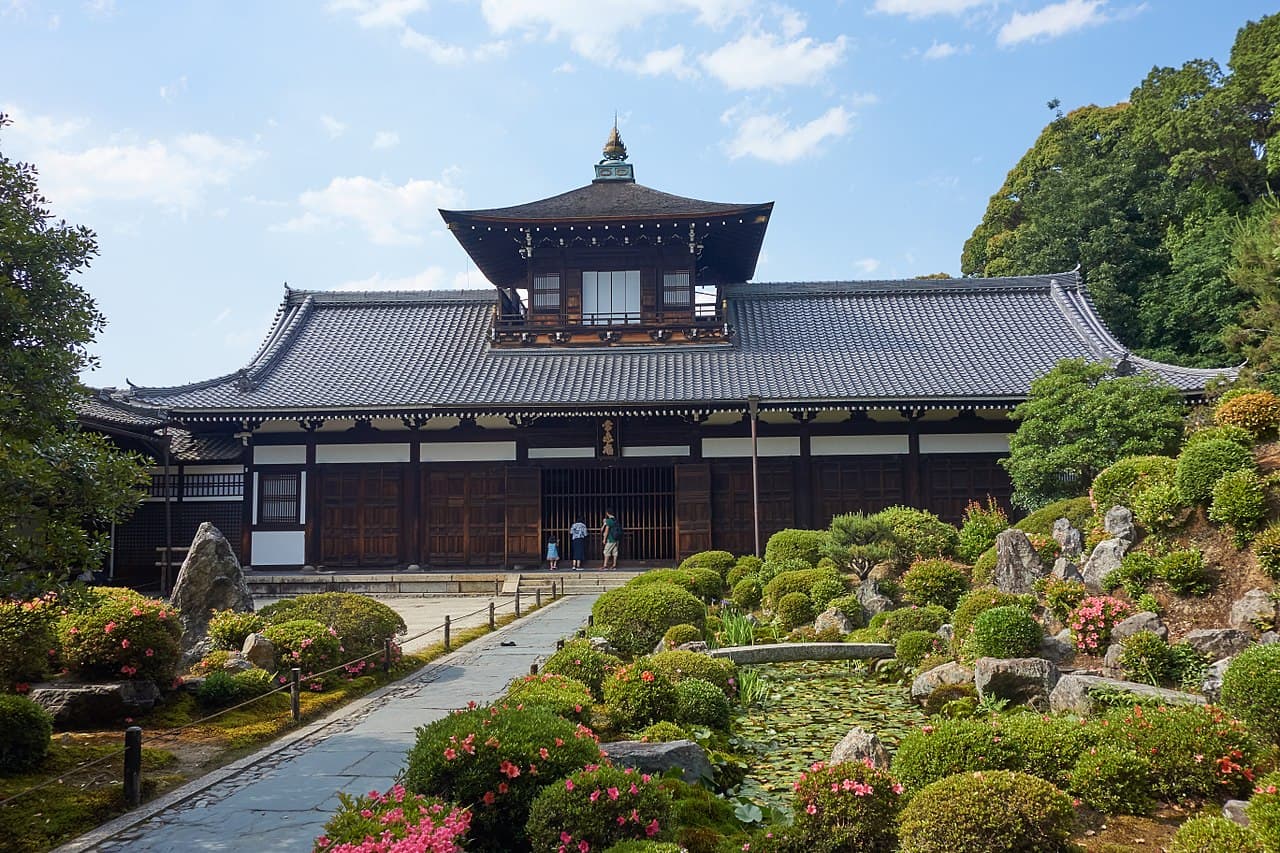
Lest you think karesansui is a dead art form, the gardens at Tōfuku-ji prove otherwise. Re-designed in 1939 by the great modernist landscape architect Shigemori Mirei, they are a brilliant fusion of ancient principles and bold, 20th-century aesthetics.
The most famous of the four gardens is the North Garden, a checkerboard of square stones and clipped azalea bushes that fade into a mossy background. It’s a pattern that feels both completely modern and deeply traditional, a pixelated version of a natural landscape. Shigemori’s work shows that the grammar of karesansui can still be used to write new and startlingly original sentences.
Loading listing...
More Than Meets the Eye: Listening to the Garden
So much of the discussion around karesansui is visual, but the experience is multi-sensory. What does a rock garden sound like?
Mostly, nothing. And that's the point. The high temple walls, the soft moss, and the sound-absorbing gravel are meticulously engineered to swallow the noise of the outside world. This cultivated silence isn't empty; it creates a space where you can hear the subtle sounds of nature such as the wind in the pines, or the call of a single bird.
Pay attention to how the garden changes with the time of day and the season. The long, dramatic shadows of a winter afternoon give the rocks a powerful, sculptural weight. The soft light after a rain shower makes the moss glow with an impossible green. The garden is never the same twice; it is a living thing, constantly in dialogue with the world around it.
A Traveler's Guide to Contemplation
When you finally find yourself on that wooden veranda, how do you approach it?
- Stop and sit. These gardens were designed to be viewed from a specific, seated position. Find that spot and give yourself time. Don't just snap a photo and leave.
- Breathe. Let your eyes soften. Don't try to "figure it out" immediately. Take in the whole composition first, then let your gaze wander to the details; for example, the texture of a single rock or the precision of a raked line.
- Listen. Tune into the soundscape. Notice the silence and the subtle sounds that punctuate it.
- Let go. The point is not to find a single, correct "meaning." The point is to allow the garden to quiet your own internal monologue. If your mind wanders, that’s okay. The garden is simply a focal point, an anchor for a moment of quiet reflection.
A karesansui garden is a mirror. It offers no easy answers, only a silent, beautiful space. What you find there has as much to do with what you bring to it as what the long-dead monks put into it. It’s not just rocks and sand. It’s an invitation to see the world, and perhaps yourself, a little differently.